
Summer Marketing Trends
Median close price: $605,000. Up 2.95% year over year, down 1.54% from June on normal seasonal cooling. Prices aren’t stalling; they’re being held up by something structural.
Here’s the real story: median days in MLS jumped 16.67% month over month to 21 days. Sellers with room to wait are waiting. Sellers who can’t wait are getting punished for it.
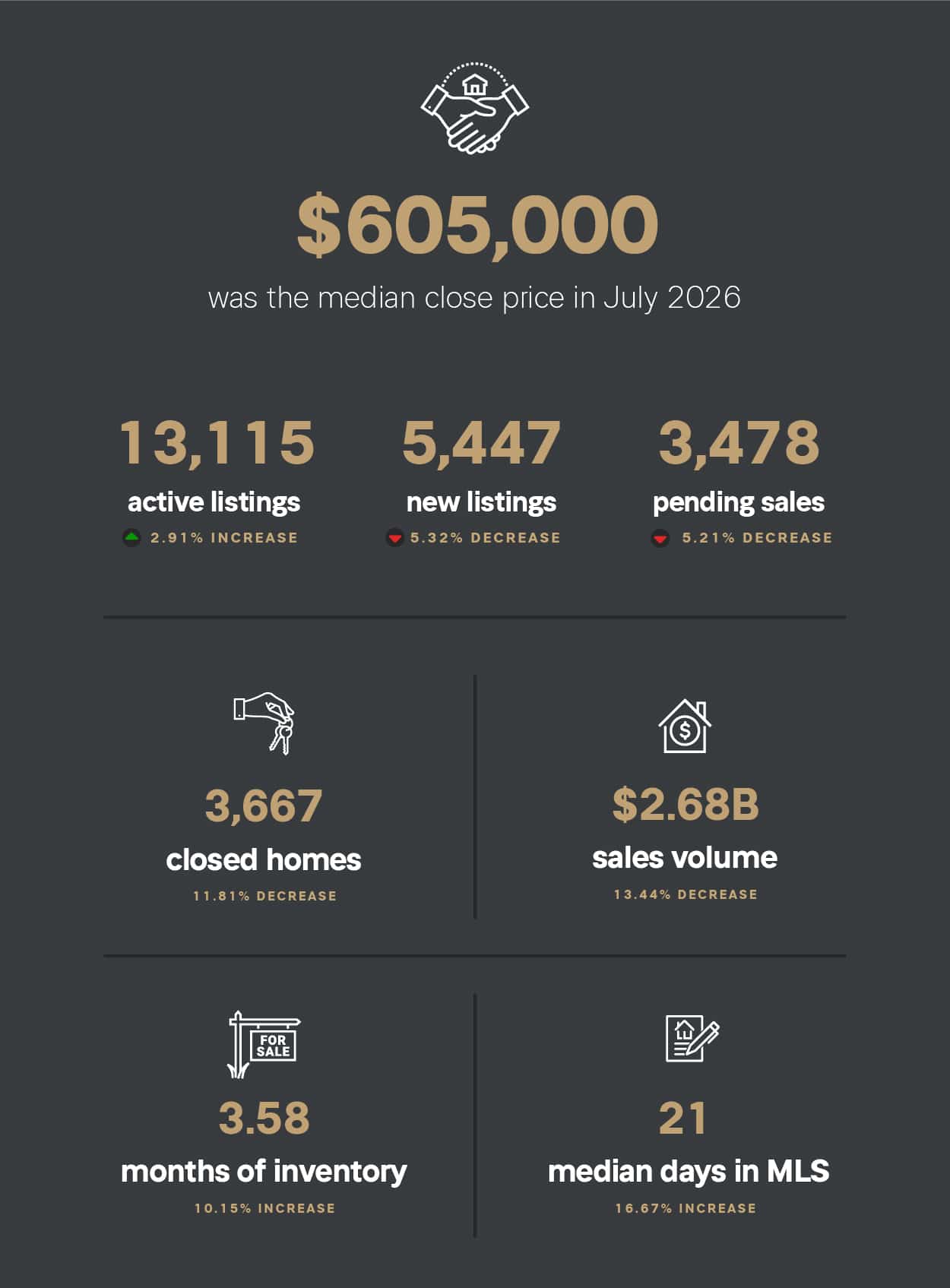
New listings fell 5.32% month over month. Closed sales dropped 11.81% month over month and 5.68% year over year. Less coming on, less moving off, same pattern we’ve been tracking.
Detached and attached continue to split further apart. Detached median closed at $660,000, up 1.54% year over year with just under three months of supply, a pace closer to a seller’s market than a buyer’s. Attached closed at $380,000, down 2.56% both month over month and year over year, sitting on nearly 5.7 months of supply. That’s buyer’s market territory, and first-time buyers in this segment are the ones absorbing it.
The $750K to $999,999 segment remains the center of gravity, and it’s cooling. 590 closed in July, down 13.24% from June. Inventory in this band dropped 8.70% month over month too, so demand isn’t collapsing faster than supply; both are pulling back.
The close-price-to-list-price ratio held at 99.00%, basically flat since June. Patience on timing still isn’t translating into real price negotiation.
Why Prices Aren’t Falling
The gap between what new buyers are financing at and what existing homeowners are locked into is the widest we’ve measured in more than 40 years. Freddie Mac’s own research says this exact scenario hasn’t existed at this scale in that stretch. Roughly half of all outstanding mortgages are still under 4%. New buyers today are financing near 6.9%. That’s the floor holding prices up while everything else in the market slows down.
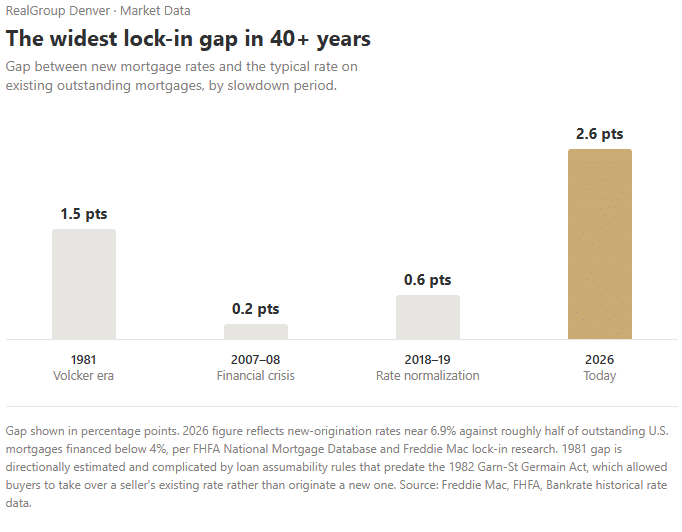
Compare that to the last two slowdowns Denver actually lived through. Heading into 2008, most sellers had financed within the prior few years at rates barely different from what new buyers were paying, so there was no gap to defend and no reason to sit tight. Same story in 2018. This time is different because the gap itself is different. Sellers today aren’t waiting because they’re nervous. They’re waiting because giving up a sub 4% rate to buy back in at 6.9% is a five figure annual cost, and that’s math, not sentiment.
That’s the floor. It’s not a feeling in the market, it’s arithmetic, and it’s why prices are drifting rather than falling even as days on market stretch out.
What this means for you
Buying: We’re going to be direct because the truth serves you better than comfort. This is not a buyer’s market. Quality inventory is scarce enough that well priced, well kept homes are still drawing multiple offers. What you’re seeing more of is quantity, not quality, and stale listings do give you room to negotiate, but only to a point. A seller sitting on a 3% rate has a payment so low that taking a lower offer often doesn’t pencil out for them, no matter how long the home sits. If you want to find where the real negotiating room is, look at listings where the home was purchased or refinanced from 2023 forward. Those sellers don’t have the same cushion, and that’s where the motivated conversations are happening.
Selling: Price it right and skip the projects. You get one real shot at this, and it’s the first week on market. Lowering the price later doesn’t bring buyers back to look again, it just confirms what they already suspected. Our advice is going to sting sometimes, because we’ll often suggest a price below your comps. We say it anyway, because getting it right the first weekend is worth more than defending a number that isn’t moving anyone to show up.
For our relocation clients, this is exactly the environment rent first, buy when you’re ready was built for. You can’t learn this market from a headline. You learn it by living in it, on the ground, with someone who can tell you which listings are actually motivated and which ones are just tired.

 CALL US NOW